

-
Tel : +86 20 8278 0427
-
Correo electrónico : info@stsystemplc.com
Tel : +86 20 8278 0427
Correo electrónico : info@stsystemplc.com
If alarms cannot become evidence, every future fault may still require trucks, lane closures and supplier explanations.
Smart street lighting projects rarely fail during the demonstration. They fail later, when the owner cannot prove which lamp, gateway, alarm, maintenance action or energy record is still reliable.
Use this article if your team is comparing smart street lighting suppliers, global platform brands or low-price alternatives, and the real concern is not the dashboard demo but what remains verifiable after project acceptance.
The key question is simple: can the Interconnected system keep asset identity, alarm history, gateway evidence, energy records and maintenance workflow reviewable without forcing the owner back to blind bucket-truck inspection?
During acceptance, the dashboard may look complete. Lamps may dim correctly. Alarms may appear on screen. The supplier may claim energy saving, remote control and intelligent maintenance. But six months later, the owner often faces a harder question:
For city, highway and tunnel lighting projects, the real risk is not only whether the lamps can be switched, dimmed or monitored. The real risk is whether energy records, alarm history, asset identity, gateway data and maintenance actions remain traceable after the project is accepted.
An Interconnected smart lighting project should not become a blind system after the supplier leaves the site.
Owners and EPC teams may begin by comparing broad solutions such as smart street lighting system, street light control system, IoT street lighting platform or tunnel lighting control system. But serious buyers usually move quickly into deeper engineering questions: can the supplier prove handover records, reduce maintenance cost, avoid vendor lock-in, retain gateway evidence and keep alarm history reviewable after acceptance?
Owners should check whether handover files can still explain control failure, vendor lock-in, owner data access, missing alarm history and gateway evidence after the supplier leaves the project.
Maintenance teams should ask whether the system can reduce bucket-truck dispatch, cherry-picker work, aerial-lift repair, scissor-lift lamp replacement and repeated truck rolls.
When comparing Signify, Schréder, Siemens, Schneider, Cisco or other platforms, the owner should review field evidence, data ownership and maintenance continuity, not only dashboard functions.
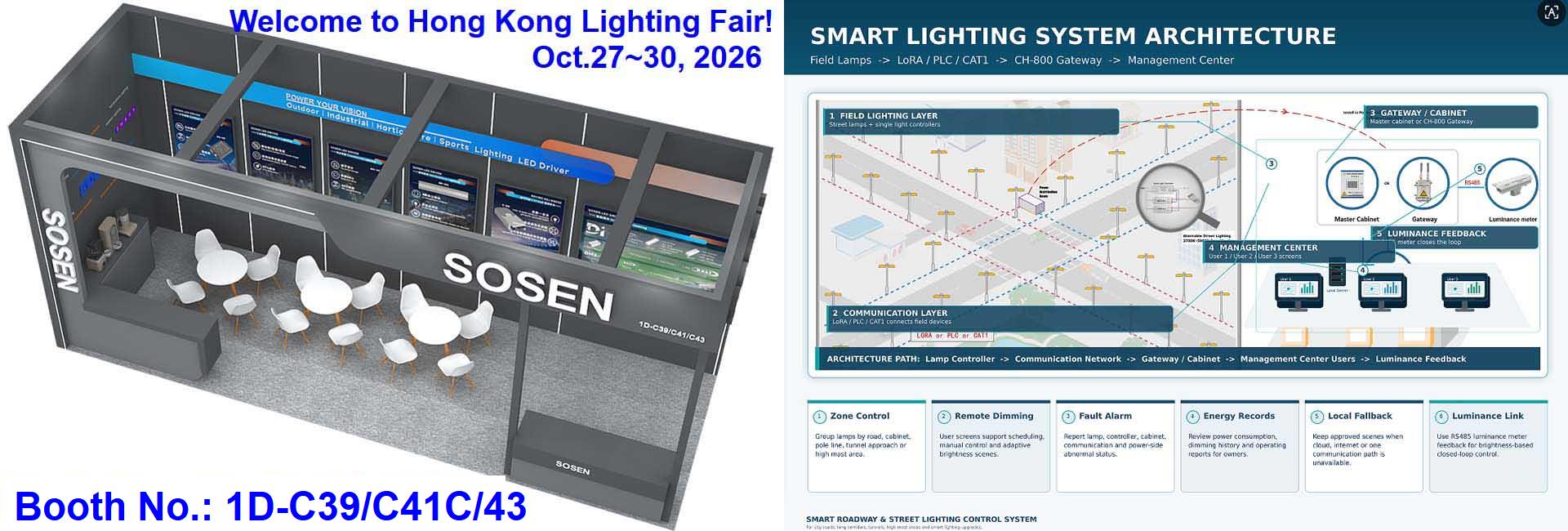
A complete Interconnected review should connect the AI-ready platform, CH-800 Gateway, centralized controller, PLC + LoRA communication and on-premise management requirements.
The reason large corridor projects matter is simple: scale exposes weak systems quickly. A small demo can hide many problems. A long road, highway or tunnel lighting project cannot. When thousands of lamps, controllers, gateways, cabinets, sensors and operators are involved, the system must be organized around evidence, not only control commands.
A successful demo is only the beginning.
In many Interconnected smart lighting projects, the demonstration focuses on visible functions:
These questions are useful, but they are not enough.
A real project continues after acceptance. Roads remain in operation. Tunnels require safe lighting transitions. City maintenance teams need clear fault locations. Owners need energy records that can be reviewed later. EPC contractors need a system that does not create endless after-sales disputes.
The project is not truly accepted when the lamps respond once. The project is truly accepted when the owner can continue to operate, review and verify the system without depending on the supplier for every explanation.
Buyers comparing Signify, Schréder, Telensa, Tvilight, Itron, Dimonoff, Flashnet, CIMCON or other Interconnected smart street lighting platforms should not only compare dashboard features. The long-term question is whether energy records, alarm history, gateway zones, asset identity, maintenance actions and owner-held operating records remain reviewable after handover.
For city, highway and tunnel lighting owners, another important question is lifecycle responsibility. A resilient smart lighting project should be built on long-term spare-part continuity, defined software support, owner-controlled data, measurable service levels and clearly defined supplier-transition responsibilities. Some new suppliers may offer very aggressive low-price proposals to win early projects, but if the company cannot develop healthily, the owner may face a serious problem in the fifth, seventh, eighth or tenth year: the system still exists, but the original maintenance and upgrade team can no longer be found.
A single-device supplier may compete for camera, sensor, controller or luminaire replacement searches. An Interconnected IoT lighting supplier can compete across a wider procurement chain: field controller, intelligent cabinet, CH-800 Gateway / Centralized Controller, PLC + LoRA communication, software platform, energy evidence, maintenance workflow, FAT/SAT handover and owner data governance.
This is the higher-value procurement question: not only "which product should I buy", but "which supplier can keep a city, highway or tunnel lighting system recoverable after acceptance?"
This section is designed for owners, EPCs, consultants and strategic partners already comparing global lighting, automation, networking, cloud or energy-management brands. The point is not to criticize a brand name. The point is to ask whether the delivered project can become one owner-controlled, Interconnected AI-Ready operating system from luminaire to cabinet to gateway to data layer to handover evidence.
For Interconnected AI-ready replacement evaluation, the owner should compare whether the supplier can define asset identity, gateway zoning, local fallback, data quality flags, interface responsibility, AI recommendation authority and handover recovery before the price table is finalized.
A stronger AI story only matters when it becomes witnessed evidence: FAT records, SAT records, abnormal-condition tests, signed exceptions, backup files, data definitions and a recoverable owner operation package.
| Target Brand / Route | Typical Buyer Perception | STSYSTEMPLC Interconnected AI-Ready Counter-Position | Procurement Question to Open |
|---|---|---|---|
| Signify / Schréder route | Strong luminaire brand, smart lighting ecosystem and municipal visibility. | STSYSTEMPLC can support an Interconnected control architecture around existing or selected luminaires, cabinet upgrades, private deployment, gateway evidence and project-specific integration. | Can the owner retain energy records, alarm history, interface evidence and maintenance continuity without being locked into one proprietary ecosystem? |
| Siemens / Schneider / ABB route | Strong power automation, infrastructure credibility and cabinet-side control language. | STSYSTEMPLC focuses on Interconnected lighting-specific implementation: lamp controller, cabinet logic, gateway record, dimming strategy, fault records, sensor scenes and road/tunnel commissioning. | Does the proposal include lighting-specific returned state, pole identity, adaptive dimming scenes and tunnel emergency behavior, or only general automation? |
| Cisco / IT network route | Strong network, platform and smart-city data story. | STSYSTEMPLC keeps the field lighting operation local-first: approved lighting behavior can continue by controller and gateway rules when WAN, server or cloud connection is unavailable. | Which lighting functions continue locally if the smart-city platform, network or AI service is interrupted? |
| Telensa / Tvilight / Itron route | Recognized smart street lighting controls, wireless networking and platform experience. | STSYSTEMPLC can organize Interconnected PLC + LoRA + project-selected NB-IoT, CAT-1, Ethernet or fiber routes around long-corridor failure domains, gateway zones and owner review. | Can the platform prove control feedback, gateway-zone responsibility and handover data years after acceptance? |
| Flashnet / Dimonoff / CIMCON route | Flexible smart lighting platform, dashboard functions and remote control options. | STSYSTEMPLC puts the acceptance boundary on engineering evidence: FAT/SAT files, asset identity, alarm closure, energy records, maintenance workflow and recoverable configuration backups. | Does the owner receive a recoverable operating package, or only a supplier-managed dashboard account? |
| Low-price new supplier route | Attractive first purchase cost and aggressive project entry price. | STSYSTEMPLC emphasizes long-cycle project continuity, spare-part logic, owner-held records and field-proven roadway/tunnel deployment evidence. | What happens in year five, seven or ten if the supplier cannot maintain the software, gateway firmware, device mapping or replacement parts? |
When alarm location, controller identity and gateway zones are unclear, the owner still pays for bucket trucks, cherry pickers, aerial work platforms, scissor lifts, boom lifts, MEWPs, manlifts, crane trucks, lane closure, night crews and repeated maintenance visits.
This is why maintenance teams comparing equipment and service resources such as Altec, Versalift, Terex Utilities, Bronto Skylift, Ruthmann, Palfinger, Socage, CTE, Genie, JLG, Haulotte, Skyjack, Dingli, Sinoboom, Zoomlion or XCMG should also check whether the Interconnected lighting system can reduce unnecessary truck rolls through accurate alarms, asset identity and owner-reviewable records.
For practical maintenance planning, the owner should also review pain points such as bucket truck street light maintenance, aerial lift lighting repair, scissor lift lamp replacement, boom lift roadway lighting service, street light fault location and smart lighting maintenance software. The real question is whether the platform can reduce blind inspection before the truck is dispatched.
| Selection Question | Short-Term Comparison | Long-Term Owner Risk |
|---|---|---|
| Dashboard appearance | Maps, charts and remote control screens look complete during the demonstration. | The owner still needs reviewable records after the project is accepted. |
| Low-price proposal | The first purchase may look attractive. | If the supplier cannot support the project years later, maintenance, upgrades and data continuity become difficult. |
| Supplier transition | The project may rely on one vendor's accounts, tools, documents and configuration knowledge. | The owner should retain access, records, backups and transition documents so an authorized successor can continue operation if needed. |
| Cloud platform promise | The interface may be easy to present. | Field schedules, gateway records and local operation should remain organized when external communication is restricted or interrupted. |
| Brand or platform selection | Owners may compare known international platforms and newer alternatives. | The decisive question is whether the system can still be operated, verified and upgraded across the full lifecycle. |
Before comparing Interconnected smart lighting suppliers, owners should review field evidence first. STSYSTEMPLC has supported large-scale roadway and tunnel lighting control experience across 2015-2024 project cycles, with deployment experience covering 2,600+ tunnels, 3,000+ km of roadway and tunnel scenarios and about 65% of China's expressway tunnel coverage context. Project evidence includes 55 km Hong Kong-Zhuhai-Macao Bridge, one of the Seven Wonders of the modern world, with nearly USD 20 Billions investment scale, 93 km Shenzhen Outer Ring Expressway, 177 km / 28,000-terminal Guangfozhao Expressway, and Shenzhen-Zhongshan Link project context with USD 6.7 billion class world-first 8-lane undersea tunnel + bridge engineering and record-breaking technical difficulty.
These projects are not short demonstrations. They test field control, CH-800 Gateway / Centralized Controller organization, PLC and LoRA communication planning, alarm records, energy data, cabinet coordination, maintenance workflow and owner handover logic at a scale that ordinary platform comparisons cannot fully represent.
Interconnected smart lighting failure after handover is usually not a single dramatic breakdown. It is often a slow loss of clarity.
The owner may still see a dashboard, but the field evidence becomes unclear. Alarm records may exist, but they are not linked to real assets. Energy-saving claims may be shown as a percentage, but the owner cannot review the data logic. Maintenance actions may happen, but they are not connected to fault history.
| Handover Risk | What the Owner Experiences |
|---|---|
| Unclear asset identity | The owner cannot confirm which lamp, pole, controller or cabinet caused the issue. |
| Weak alarm history | Alarms appear, but they do not become traceable maintenance records. |
| Estimated energy saving | The supplier reports a percentage without owner-verifiable energy data. |
| Cloud-only dependency | Field operation becomes uncertain when external communication is interrupted. |
| Poor gateway zoning | The owner cannot clearly connect field devices with gateway zones and control logic. |
| No maintenance evidence | Fault handling depends on verbal updates instead of records. |
This is why Interconnected smart lighting should be evaluated as an operation system, not only as a control product.
Owners that need alarms to become traceable service actions can continue with the Interconnected Smart Street Light Maintenance System, including fault reporting, work orders, controlled diagnostics, maintenance evidence and owner-reviewable closure records.
Energy saving claims are easy to write. Owner-verifiable energy records are harder.
For procurement teams, the key acceptance question is whether energy-saving data remains traceable, reviewable and audit-ready after the project is accepted. A percentage on a brochure is not enough. A dashboard screenshot is not enough. A one-time test is not enough.
| Owner Question | Weak Answer | Evidence-Based Answer |
|---|---|---|
| How was energy saving calculated? | Estimated comparison | Time-based operating and energy records |
| Can records be reviewed later? | Supplier report only | Owner-accessible data history |
| Can different zones be compared? | General project average | Area, gateway or cabinet-level records |
| Can abnormal consumption be checked? | Manual inspection | Data-linked alarm and review logic |
For road, highway and tunnel lighting projects, energy saving is not only a sales promise. It becomes part of owner acceptance, budget review, maintenance planning and long-term operation.
If the energy record cannot be reviewed later, the claim becomes weak after handover.
An alarm is not the end of a maintenance process. It is the beginning.
In a weak system, an alarm appears on screen and then disappears into manual communication. Someone takes a screenshot. Someone calls a maintenance team. Someone writes a note. Later, when the owner asks what happened, the answer may depend on memory.
In an evidence-based Interconnected smart lighting system, the alarm should connect with asset identity, location, gateway zone, fault type, handling status and maintenance record.
The owner should be able to see:
This is especially important for highways and tunnels, where lighting is part of safe operation. A fault record is not only a technical message. It is an operational responsibility.
An Interconnected smart lighting system cannot be reliable if field assets are only names on a drawing. Each important asset should have a clear digital identity.
| Asset Layer | Why It Matters |
|---|---|
| Lamp | Confirms lighting point and maintenance target. |
| Single-lamp controller | Connects dimming, alarm and control status. |
| Pole or installation point | Supports field maintenance and location review. |
| Intelligent cabinet | Links power, circuit and control protection. |
| Gateway / Centralized Controller | Organizes field communication and zone control. |
| Sensor | Supports adaptive lighting and scene response. |
| Software account / operator role | Supports owner-side operation control. |
Without asset identity, an Interconnected smart lighting project can become visually impressive but operationally weak. The map may look good, but the maintenance team still struggles to answer a basic question: which field device should we inspect?
In many projects, the gateway or centralized controller is treated as a communication device. That is too narrow.
For large Interconnected smart lighting projects, the gateway should also become part of the evidence layer. It helps organize field devices, local schedules, communication status, control feedback and operation records.
A strong gateway layer can support:
This matters because external networks are not always stable. In some projects, owners may restrict internet access for security reasons. In some regions, mobile networks may be unreliable. In tunnels and long corridors, communication routes may be complex.
A lighting control system should not depend only on a beautiful cloud interface. The field layer must remain trustworthy.
For cabinet-side circuit control, sensor linkage and local operating continuity, review the Interconnected Intelligent Street Lighting Cabinet. For city-scale software, sovereign on-premises deployment and owner-visible operating records, review the Smart City Lighting Management System.
In small projects, the owner may focus mainly on device price and basic control. In large road, highway and tunnel projects, the question changes.
The owner must ask whether the system can remain organized across long distances, many devices, multiple teams and years of operation.
These projects show why Interconnected smart lighting cannot be judged only by a short demonstration. Long corridors require structured communication, gateway organization, fault evidence, energy records, field control and owner handover logic.
Scale does not forgive unclear systems.
Before accepting an Interconnected smart street, highway or tunnel lighting project, owners should ask suppliers for evidence in several areas.
| Acceptance Item | What to Check |
|---|---|
| Energy records | Can energy data be reviewed by time, zone or project area? |
| Alarm history | Are fault records stored, traceable and linked to assets? |
| Asset identity | Are lamps, controllers, poles, cabinets and gateways clearly organized? |
| Gateway zones | Can the owner understand which gateway controls which field area? |
| Local autonomy | Can schedules or safe scenes continue during communication interruption? |
| Maintenance records | Can alarms become work orders or maintenance actions? |
| Owner access | Can the owner review records after handover without relying only on supplier explanations? |
| Expansion logic | Can the system support more roads, tunnels, cabinets or lighting zones later? |
This checklist is not only for technical teams. It is also for procurement, EPC contractors, consultants and project owners who must avoid long-term operation risk.
Long-term acceptance should also define spare identity, software support, service levels, configuration recovery and supplier-transition responsibility. The Interconnected Smart Street Lighting Warranty and Lifecycle Responsibility page provides the complementary procurement framework.
AI-assisted lighting is becoming a popular topic in smart city projects. But AI should not be placed above a weak field layer.
If the system cannot provide reliable asset identity, alarm history, energy records, gateway evidence and maintenance data, AI-assisted review has little foundation. The system may generate dashboards, summaries or predictions, but the owner still cannot verify the field reality.
Interconnected AI-ready smart lighting should begin with trustworthy field control.
The order should be:
AI is valuable only when the evidence layer is strong enough to support it.
Use these engineering routes to continue from the handover risk discussed in this article to the relevant system, field-control and lifecycle solution.
The main solution page connecting controllers, cabinets, CH-800 gateways, software, communications and owner operations.
Long-corridor control, offline local operation, PLC + LoRA networking, sensing and project-defined interfaces.
Connect fault location and asset identity with work orders, service evidence and maintenance closure.
Define lifecycle responsibility, spare-part continuity, data access, service levels and recovery evidence.
Review the gateway layer that organizes field communication, schedules, alarms, device groups and returned status.
Open the STSYSTEMPLC download center for available technical documents, catalogs and engineering reference material.
Failure usually begins when asset identity, alarm history, gateway zoning, credentials, configuration backups, maintenance actions and data ownership were not fully defined or witnessed during FAT and SAT. The dashboard may remain visible while the owner gradually loses verifiable control of the field system.
It can when approved schedules, safe scenes and local rules are stored and executed by the field controller, intelligent cabinet or CH-800 gateway. The exact fallback behavior, duration, authority and recovery sequence must be specified and tested for the project.
The contract should define owner access to asset records, alarms, energy data, operator history, credentials, interfaces, configuration backups and exports. Hosting may be cloud, private cloud or owner-controlled on-premises, but authority and recovery rights should not remain ambiguous.
Each alarm should retain time, asset identity, location, gateway zone, fault type, acknowledgement, assigned action, service evidence and closure status. This creates a reviewable chain from field fault to completed maintenance instead of relying on screenshots or verbal updates.
Specify owner-held credentials, exportable records, documented interfaces, recoverable configurations, spare compatibility, supplier-transition files and acceptance tests. Procurement should evaluate the recovery route before approving the platform, not after support becomes unavailable.
Testing should witness device identity, command feedback, alarm persistence, energy records, local fallback, gateway-zone mapping, role permissions, communication-loss behavior, backup recovery, data export and closure of project exceptions.
Accurate asset identity, fault type and gateway-zone evidence allow maintenance teams to prepare the correct crew, spare and access equipment before lane closure. This reduces blind inspection, repeated truck rolls, unnecessary night work and avoidable lift deployment.
Compare more than luminaires, network coverage or dashboard appearance. Review field-control continuity, owner data, interface responsibility, gateway evidence, FAT/SAT records, maintenance closure, supplier-transition support and proven deployment scale.
Buyers should compare the complete system scope behind smart street lighting system, IoT street lighting platform, street light control system, tunnel lighting control system, AI-ready lighting platform, Signify alternative, Schréder comparison, Siemens lighting control, Schneider smart city lighting and Cisco smart city network lighting discussions.
A single device may solve one visible function. An Interconnected IoT lighting system links controllers, intelligent cabinets, CH-800 gateways, communications, software, alarms, energy records, maintenance actions and owner data into one recoverable operating architecture.
For a project-specific review, send the project type and length, luminaire quantity and brand, cabinet and gateway quantity, communication preference, server policy, local fallback requirement, sensing strategy, owner-data requirement, FAT/SAT scope, maintenance access cost and expected schedule.
Review the Complete Interconnected System Open Technical DownloadsBefore accepting an Interconnected smart lighting project, owners should ask one simple question:
Can this system still prove energy saving, alarm history, asset identity and maintenance action after the supplier leaves the site?
If the answer is unclear, the project may look smart during the demo but become difficult after handover.
Interconnected smart lighting should not only control lamps. It should help owners operate, verify, maintain and review the lighting system over its full lifecycle.
STSYSTEMPLC designs Interconnected smart street, highway and tunnel lighting control around gateway evidence, field control, alarm records, energy data, asset identity and owner handover logic, supporting city-scale and long-corridor lighting projects where operation evidence matters after acceptance.
Continue to the complete Interconnected smart street, highway and tunnel lighting system, or open the street light maintenance solution for fault, work-order and service-evidence planning.

Habla a : F4,Bldg A, Hanzhong Industrial Park, No.67, North of Xinsha Ave, Xin Tang, Zeng Cheng, Guang Zhou, China
Tel : +86 20 8278 0427
Correo electrónico : info@stsystemplc.com
Correo electrónico : morrison426@163.com